Blake Vanderhyde is a licensed Minnesota attorney based in the Minneapolis area. He is the founder and principal of Vanderhyde Law, a mass tort plaintiff practice; the founder of Vanderhyde Consulting, an AI consulting practice; and the co-founder of A4A, Inc., a company building artificial intelligence tools for plaintiff law firms.
For more than two decades he has worked at the intersection of legal practice and marketing technology.
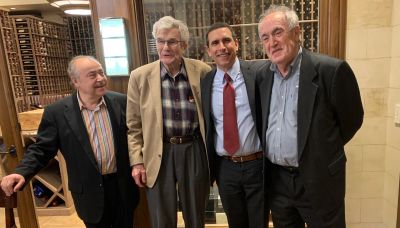
From 2020 to 2025 he served as a consultant and public health advocate focused on antimicrobial resistance. That work brought him into a sustained collaboration with former U.S. Senator Rudy Boschwitz; Michael Afremov, co-founder of AGA Medical Corporation, which St. Jude Medical acquired in 2010; and Dr. Eliaz Babaev, a Soviet-trained physicist holding more than one hundred international patents.
Today, his primary work centers on the responsible use and application of artificial intelligence for plaintiff law firms to help individuals harmed by defective products, dangerous drugs, and other mass torts.

Blake is co-leading the development of A4A, Inc., a company building artificial intelligence tools that help plaintiff law firms communicate more effectively, scale their marketing infrastructure, and connect more victims of mass injury with qualified legal support.
Through Vanderhyde Consulting, Blake writes and advises on artificial intelligence in the legal profession. His work examines how lawyers and law firms can adopt AI tools responsibly, with attention to professional judgment, confidentiality, ethics, marketing compliance, and the practical realities of law firm operations.
Blake also continues to maintain his Minnesota legal practice through Vanderhyde Law.

Antimicrobial Resistance: A Five-Year Investigation is a twenty-seven-part public investigation written and published by Blake Vanderhyde.
The investigation examines the global antimicrobial resistance crisis, drawing on five years of consulting and public health advocacy work. It spans the scientific, regulatory, commercial, and ethical dimensions of the crisis, and examines a non-pharmaceutical approach to antibiotic-resistant bacterial infection.
The work includes a sustained self-examination titled "What Could Go Wrong: An Honest Assessment," in which the entire thesis is stressed against its regulatory, scientific, commercial, and ethical risks, and closes by offering the framework freely to any qualified researcher, clinician, regulator, or operator who wishes to build on it.
Vanderhyde currently holds no equity, board position, or financial stake in the technology discussed in the investigation, and received no compensation for the work.
Published in full on Medium: Antimicrobial Resistance: A Five-Year Investigation
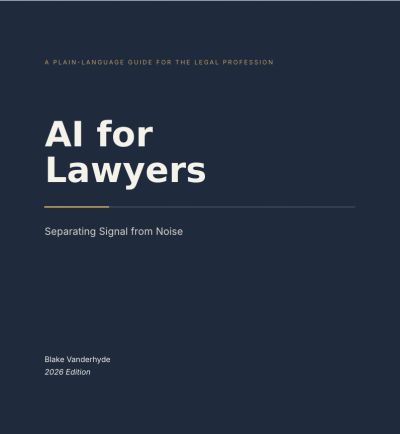
The AI for Lawyers Series – Separating Signal from Noise by Blake Vanderhyde is written for practicing attorneys, law firm leaders, and legal professionals who want to understand artificial intelligence clearly, practically, and without hype.
The series addresses both the legitimate concerns lawyers have about AI and the opportunities the technology may create when used with care, judgment, and professional discipline. Topics in the series include lawyer hesitation about AI, hallucinated legal citations, confidentiality and privilege, high-risk and lower-risk use cases, law firm strategy, AI vendor evaluation, legal marketing applications, and the ethical obligations lawyers must consider when adopting AI tools.
The goal of the series is to help lawyers think clearly about where artificial intelligence belongs, where it does not belong, and how the legal profession can use it responsibly.
Published on Vanderhyde Consulting and on LinkedIn

Upcoming Work on AI, Plaintiff Marketing, and Access to Representation
Blake is also preparing a second series examining the application of artificial intelligence to plaintiff legal marketing, victim outreach, and access to representation. The series will address a long-standing structural problem in plaintiff legal practice: too many victims of mass injury never reach the right law firm because effective outreach is expensive, complex, and difficult to coordinate across modern communication channels.
The series will explore how artificial intelligence may help reduce those costs, expand reach, improve communication, and connect more victims with qualified counsel, while preserving the ethical duties that define the legal profession.
This will be published on Vanderhyde Consulting and LinkedIn in 2026.
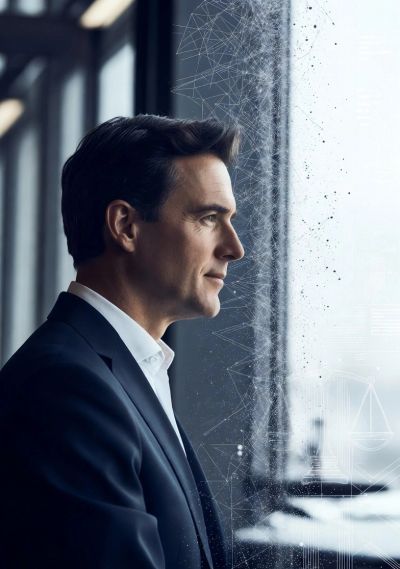
Blake Vanderhyde is a licensed Minnesota attorney whose career has spanned a traditional legal practice, mass tort marketing, digital strategy, public health advocacy, and applied artificial intelligence.
He began his career handling cases in the traditional way before recognizing that search engines were quietly reshaping how legal clients found their lawyers. In the late 1990s he taught himself search engine optimization, reverse engineering Google's algorithms through trial and observation.
Over the next two decades he operated a vast network of websites focused on plaintiff legal lead generation, mass tort campaigns, and competitive intelligence. The operation became one of the most sophisticated of its kind in plaintiff legal marketing.
As the work scaled, he began partnering and co-counseling with firms across the country, expanding beyond traditional casework into growth strategy, systems architecture, and scalable business development. His legal career has involved many of the most significant mass tort and multidistrict litigations in U.S. history, with an emphasis on pharmaceutical and medical device injury claims and cases arising from toxic and environmental exposures.
In 2020, his work took an unexpected turn.
During the early months of the COVID-19 pandemic, Blake’s chance encounters with former U.S. Senator Rudy Boschwitz grew into a five-year collaboration focused on combating antimicrobial resistance. Blake introduced Boschwitz to entrepreneur Michael Afremov, co-founder of AGA Medical Corporation, who in turn connected them with Dr. Eliaz Babaev, a physicist and prolific inventor known for his work in therapeutic ultrasound.
Their efforts centered on the Qoustic Wound Therapy System, a low-frequency ultrasound device being studied for its potential effects on antibiotic-resistant bacteria. Early laboratory research suggested the technology could possibly disrupt bacterial cell walls and reduce bacterial counts, although clinical studies would be needed to confirm any therapeutic benefit. Read the full account here.
The opportunity, the team, and the scale of the underlying problem prompted Blake to found Vanderhyde Consulting in 2020. Although a sharp departure from his legal work, the potential human impact made the work impossible to ignore.
Over the next five years the work brought Blake into meetings and communications with sitting U.S. Senators and members of the House of Representatives, senior White House staff, federal regulators at the Food and Drug Administration and National Institutes of Health, board members of healthcare and technology companies, lobbyists representing public health interests, and Fortune 500 executives across healthcare and finance.
He examined the antimicrobial resistance crisis from multiple angles, studying the underlying physics, the regulatory pathways available to a novel device, the clinical trial design questions, the financial structures required for translation to clinical use, and the ethical considerations of advancing investigational technology in a public health emergency.
That work produced Antimicrobial Resistance: A Five-Year Investigation, a twenty-seven-part public series written and published between 2025 and 2026.
It stands as Blake's most substantial body of public work to date.
The consulting work also drew Blake into the serious, practical use of artificial intelligence. He used AI extensively to analyze regulatory options, build financial models, evaluate clinical trial frameworks, assess markets, refine strategy, and work through complex scientific research outside his formal training. The experience showed him how artificial intelligence could help professionals move faster, reduce costs, and evaluate ideas with greater rigor than was possible without it. It also changed how he thought about the future of legal practice.
For more than twenty years, Blake had wrestled with a structural problem in the legal industry that no amount of conventional marketing seemed to fully solve. Too many victims of mass tort injury never find the right firm because effective outreach is expensive, complex, and increasingly difficult to coordinate across the many channels through which people now seek help.
Effective plaintiff law firm marketing requires technical infrastructure, creative production, regulatory compliance, and continuous optimization across platforms. The cost and complexity place it out of reach for many firms that would otherwise serve victims well. Artificial intelligence, applied carefully, offered a way through.
That insight led Blake to partner with one of his oldest and closest friends, a trusted technical co-founder, to launch A4A, Inc.
A4A, Inc. is building artificial intelligence tools that help law firms communicate more effectively, scale their marketing infrastructure, and connect more people with the legal support they need.
Outside of his professional work, Blake is a daily Qigong meditator and an active volunteer. He maintains an interest in suicide prevention, support for people with disabilities, and broader work in service of those who are underserved or overlooked.
Licensed attorney, State of Minnesota.
Admitted in State and Federal Court
Founder, Vanderhyde Consulting.
Founder and Principal Attorney, Vanderhyde Law
Co-founder, A4A, Inc.
Collaborated with Former U.S. Senator Rudy Boschwitz on antimicrobial resistance advocacy and strategy
Former Advisor, Arobella Medical, LLC.
Mon | 09:00 am – 05:00 pm | |
Tue | 09:00 am – 05:00 pm | |
Wed | 09:00 am – 05:00 pm | |
Thu | 09:00 am – 05:00 pm | |
Fri | 09:00 am – 05:00 pm | |
Sat | Closed | |
Sun | Closed |